Table of Contents
Note that all rings considered here are commutative and have a multiplicative identity.
Each written proof or proof sketch is followed by a separate folded Lean 4 proof. The snippets are collected and compiled in mathlib-in-lean/commutative-algebra/Ring.lean. They assume that file’s imports, namespace CommAlg, and variable {A : Type*} [CommRing A]; later snippets may use earlier declarations.
Special Elements of Ring
-
A set of units, $A^* = \{a \in A \mid \exists b \in A, a \cdot b = 1\}$
-
A set of zero divisors, $\mathcal{D}(A) = \{a \in A \mid \exists b \in A \setminus \{0\}, a \cdot b = 0\}$
-
A set of nilpotent elements, $\mathcal{N}(A) = \{a \in A \mid \exists n \in \mathbb{N}, a^n = 0\}$
-
$a$ is idempotent if $a^2 = a$
Facts on Special Elements of Ring
-
If $A \ne 0$, then $\mathcal{N}(A) \subseteq \mathcal{D}(A)$, i.e., every nilpotent element is a zero divisor.
Proof
It is suffice to show that $\forall y \in \mathcal{N}(A) \to y \in \mathcal{D}(A)$.
By definition (3), choose the least $n \in \mathbb{N}$ such that $y^n = 0$. Since $y^0 = 1 \ne 0$, we have $n \ge 1$, so $0 = y^n = y \cdot y^{n – 1}$. By minimality of $n$, $y^{n – 1} \ne 0$. By definition (2), use $b = y^{n – 1}$, we have $y \cdot b = 0$ with $b \ne 0$, hence $y \in \mathcal{D}(A)$.
Lean 4 proof
/-- `a` is a zero divisor if `a * b = 0` for some nonzero `b`. -/
def IsZeroDivisor (a : A) : Prop := ∃ b : A, b ≠ 0 ∧ a * b = 0

/- Fact 1: in a nonzero ring, every nilpotent element is a zero divisor. -/
theorem isZeroDivisor_of_isNilpotent [Nontrivial A] {y : A} (hy : IsNilpotent y) :
    IsZeroDivisor y := by
  classical
  -- choose the least `n` with `y ^ n = 0`
  set n := Nat.find hy with hn_def
  have hn : y ^ n = 0 := Nat.find_spec hy
  -- `n ≠ 0`, since `y ^ 0 = 1 ≠ 0`
  have hn0 : n ≠ 0 := by
    intro h
    rw [h, pow_zero] at hn
    exact one_ne_zero hn
  obtain ⟨m, hm⟩ := Nat.exists_eq_succ_of_ne_zero hn0
  -- take `b = y ^ (n - 1)`, which is nonzero by minimality of `n`
  refine ⟨y ^ m, fun h => ?_, ?_⟩
  · have : n ≤ m := Nat.find_min' hy h
    omega
  · calc y * y ^ m = y ^ (m + 1) := (pow_succ' y m).symm
      _ = y ^ n := by rw [hm]
      _ = 0 := hn
-
If $A \ne 0$, then $A^* \cap \mathcal{D}(A) = \emptyset$, i.e., no unit is a zero divisor.
Proof
By contradiction, assume $A^* \cap \mathcal{D}(A) \ne \emptyset$, let $x \in A^* \cap \mathcal{D}(A)$.
By definition (1), there exists $y \in A$ such that $x \cdot y = 1$. By definition (2), there exists an non-zero $z \in A$ such that $x \cdot z = 0$.
So, we have : $$ (x \cdot y) \cdot z = 1 \cdot z = z \ne 0 $$ By the associativity and commutativity of $A$ (as we mentioned earlier that $A$ is commutative ring with identity), the left-hand side $(x \cdot y) \cdot z = (y \cdot x) \cdot z = y \cdot (x \cdot z) = y \cdot 0 = 0$.
This is a contradiction since the right-hand side is $z \ne 0$. Hence no unit can be a zero divisor.
Lean 4 proof
/- Fact 2: no unit is a zero divisor. -/
theorem not_isZeroDivisor_of_isUnit {x : A} (hx : IsUnit x) : ¬ IsZeroDivisor x := by
  rintro ⟨z, hz, hxz⟩
  obtain ⟨y, hy⟩ := hx.exists_right_inv
  -- `z = (x * y) * z = y * (x * z) = y * 0 = 0`, contradicting `z ≠ 0`
  apply hz
  calc z = (x * y) * z := by rw [hy, one_mul]
    _ = y * (x * z) := by ring
    _ = 0 := by rw [hxz, mul_zero]

example {x z : A} (hx : IsUnit x) : x * z = 0 ↔ z = 0 := hx.mul_right_eq_zero
-
Let $A$ be a finite ring. Then, $A = A^* \cup \mathcal{D}(A)$, i.e., every element of a finite ring is either a unit or a zero divisor.
Proof
Firstly, considering $A = \{0\}$, then $0 \cdot 0 = 0 = 1$, so $A^* = \{0\}$ and $\mathcal{D}(A) = \emptyset$. Hence, $A = A^* \cup \mathcal{D}(A)$ in this case.
Secondly, if $A \ne \{0\}$. By (b), we have $A^* \cap \mathcal{D}(A) = \emptyset$. Since $A^* \subseteq A$ and $\mathcal{D}(A) \subseteq A$, we have $A^* \cup \mathcal{D}(A) \subseteq A$. So it is suffice to show that $A \subseteq A^* \cup \mathcal{D}(A)$, which implies that $$ \forall x \in A \to x \in A^* \cup \mathcal{D}(A) $$
Assume $x \in A$. Consider the function $f: A \to A$ defined by $f(y) = x \cdot y$. Since $A$ is finite, $f$ is either injective or not.
-
If $f$ is not injective, then there exist distinct $y_1, y_2 \in A$ such that $x \cdot y_1 = x \cdot y_2$, which implies $x \cdot (y_1 – y_2) = 0$. Let $z = y_1 – y_2 \ne 0$, then $x \cdot z = 0$, hence $x \in \mathcal{D}(A)$.
-
If $f$ is injective, since $A$ is finite, by the pigeonhole principle, $f$ is also surjective, then there exists $y \in A$ such that $f(y) = x \cdot y = 1$, hence $x \in A^*$.
Therefore, every element $x \in A$ is either a unit or a zero divisor, i.e., $x \in A^* \cup \mathcal{D}(A)$.
Lean 4 proof
/- Fact 3: every element of a finite ring is a unit or a zero divisor. -/
theorem isUnit_or_isZeroDivisor [Finite A] (x : A) : IsUnit x ∨ IsZeroDivisor x := by
  -- consider `f : A → A`, `f y = x * y`
  by_cases hinj : Function.Injective (fun y : A => x * y)
  · -- injective ⇒ surjective (pigeonhole), so `x * y = 1` for some `y`
    left
    obtain ⟨y, hy⟩ := Finite.injective_iff_surjective.mp hinj 1
    exact IsUnit.of_mul_eq_one y hy
  · -- not injective ⇒ `x * (y₁ - y₂) = 0` with `y₁ ≠ y₂`
    right
    simp only [Function.Injective, not_forall] at hinj
    obtain ⟨y₁, y₂, h, hne⟩ := hinj
    exact ⟨y₁ - y₂, sub_ne_zero.mpr hne, by rw [mul_sub, h, sub_self]⟩
-
Domain VS Field
-
Commutative ring + (multiplicative) identity + $\mathcal{D}(A) = 0$ is an integeral domain (or domain)
-
Commutative ring + (multiplicative) identity + $A^* = A \setminus \{0\}$ is a field.
-
A finite (integral) domain is a field.
Proof
By the proof of fact (3), $\mathcal{D}(A) = 0$ implies function $f$ is injective for every non-zero $x \in A$.
By pigeonhole principle, finite implies that every injective function from the domain to itself is also surjective, which ensures that every non-zero element has a multiplicative inverse, hence the domain is a field.
Lean 4 proof
/- Fact 3: a finite integral domain is a field. -/
theorem isField_of_finite_domain [IsDomain A] [Finite A] : IsField A := by
  refine ⟨exists_pair_ne A, mul_comm, ?_⟩
  intro x hx
  -- no zero divisors ⇒ `y ↦ x * y` is injective, hence surjective
  have hinj : Function.Injective (fun y : A => x * y) :=
    fun y₁ y₂ h => mul_left_cancel₀ hx h
  exact Finite.injective_iff_surjective.mp hinj 1

example [IsDomain A] [Finite A] : IsField A := Finite.isField_of_domain A
Ideal
Ideal is a subset of a ring such that
- It is an additive subgroup of the ring. i.e. for any $a, b \in I$, we have $a – b \in I$
- It is closed under multiplication by any element of the ring, i.e., for all $a \in A$ and $x \in I$, we have $a \cdot x \in I$.
Definitions of Some Ideals
-
If an ideal $I$ is proper, then $1 \notin I$.
-
If a proper ideal $I$ is maximal if it is not strictly contained in any other proper ideal of the ring.
-
Ideal generated by a strict subset $S \subset A$ is
$$ \langle S \rangle = \left\{ \sum_{i=1}^n a_i \cdot s_i \mid n \in \mathbb{N}, a_i \in A, s_i \in S \right\}, $$ the elements of $S$ are generators of ideal $I = \langle S \rangle$. Since cardinality $|S| = n \in \mathbb{N}$ is a finite number, the ideal $I$ is finitely generated. Let $S = \{s_1, …, s_n\}$, then $I = \langle s_1, …, s_n\rangle$. -
If the cardinality of $S$ is 1, i.e., $S = \{s\}$, then the ideal $I$ generated by $S$ is principal, i.e., $I = \langle s \rangle$.
-
A ring $A$ always contains two special ideals, one is the bottom ideal $\langle 0 \rangle = \{0\}$ (denoted as $\bot$ lean), and the other is the top ideal $\langle 1 \rangle = A$ (denoted as $\top$ lean).
Special Ring
- A ring $A$ is called Principal Ideal Ring (PIR) if every ideal of $A$ is principal, i.e., can be generated by a single element. Moreover, if $A$ is also an integral domain, it is called a Principal Ideal Domain (PID).
Facts on Ideals
-
$1 \notin I \iff A^* \cap I = \emptyset$, i.e. No unit exists in a proper ideal of a ring.
Proof
(a) Regarding the forward direction, in a contrapositive way, we assume $a \in A^*, a \in I$.
-
Since $a \in A^*$, there exists $b \in A$ such that $a \cdot b = 1$.
-
Since $a \in I$, we have $\forall c \in A, a \cdot c \in I$.
Putting these two hypotheses together. we obtain $a \cdot b = 1 \in I$, which contradicts the assumption that $I$ is proper.
(b) Regarding the backward direction, assume $A^* \cap I = \emptyset$, which implies that: $$ \forall a \in I \to \urcorner(\exists b \in A, a \cdot b = 1) \\ \Updownarrow \\ \forall a \in I \to \forall b \in A, a \cdot b \ne 1 $$ By definition of ideal, $\forall b \in A, a \cdot b \in I$, therefore, $1 \notin I$.
Lean 4 proof
/- Fact 1: an ideal is proper iff it contains no unit. -/ theorem one_not_mem_iff (I : Ideal A) : (1 : A) ∉ I ↔ ∀ a ∈ I, ¬ IsUnit a := by constructor · -- if a unit `a` with `a * b = 1` lies in `I`, then `1 = a * b ∈ I` intro h1 a ha hu obtain ⟨b, hb⟩ := hu.exists_right_inv apply h1 rw [← hb] exact I.mul_mem_right b ha · -- `1` is itself a unit intro h h1 exact h 1 h1 isUnit_one example (I : Ideal A) {a : A} (ha : a ∈ I) (hu : IsUnit a) : I = ⊤ := Ideal.eq_top_of_isUnit_mem I ha hu -
-
If $A$ is a field, then it has only has two ideals: the zero ideal $\langle 0 \rangle$ and the field itself $\langle 1 \rangle = A$.
Proof
(a) Firstly, considering the special case of $A = \{0\}$, then the only ideal is $\langle 0 \rangle = \{0\}$.
(b) Secondly, consider the case when $A$ is a non-zero field. Let $I$ be a non-zero ideal of $A$. By the definition of field $A$ : $$ \forall a \ne 0 \in A, \exists b \in A, a \cdot b = 1. $$
Take any non-zero element $a \in I \subseteq A$, by definition of ideal, we have : $$ \forall b \in A, a \cdot b \in I $$ Putting these two hypotheses together, we obtain $a \cdot b = 1 \in I$. Since $1 \in I$, thus $I = \langle 1 \rangle = A$.
Completing the proof.
Lean 4 proof
/- Fact 2: a field has only the ideals `⟨0⟩` and `⟨1⟩`. -/
theorem eq_bot_or_top_of_field {K : Type*} [Field K] (I : Ideal K) : I = ⊥ ∨ I = ⊤ := by
  by_cases h : I = ⊥
  · exact Or.inl h
  · -- take a nonzero `a ∈ I`; then `1 = a⁻¹ * a ∈ I`
    right
    obtain ⟨a, ha, ha0⟩ := Submodule.exists_mem_ne_zero_of_ne_bot h
    rw [Ideal.eq_top_iff_one, ← inv_mul_cancel₀ ha0]
    exact I.mul_mem_left a⁻¹ ha

example {K : Type*} [Field K] (I : Ideal K) : I = ⊥ ∨ I = ⊤ := Ideal.eq_bot_or_top I
Ideal Operations
- Intersection. For any family of ideals $\{I_h\}_{h \in H}$ of $A$, their intersection $\bigcap_{h \in H} I_h$ is also an ideal of $A$.
- Sum. For any family of ideals $\{I_h\}_{h \in H}$ of $A$, the ideal generated by their union $\bigcup_{h \in H} I_h$ is also an ideal of $A$. It is denoted by $\sum_{h \in H} I_h$. That is exists a function : $$ f: \bigcup_{h \in H} I_h \to \sum_{h \in H} I_h = \{ \sum_{i=1}^n a_i \mid a_i \in I_{h_i}, h_i \in H, n \in \mathbb{N} \} $$ which is inclusion map. $\sum_{h \in H} I_h$ is smallest ideal containing $\bigcup_{h \in H} I_h$.
-
Product. For any finite family of ideals $\{I_h\}_{h \in H}$ of $A$, their product ideal $\prod_{h \in H} I_h$ is generated by
$$ \left\{ \prod_{h \in H} x_h \mid x_h \in I_h \text{ for all } h \in H \right\}. $$Observations
Fact : $I^k \subseteq I^{k – 1} \subseteq \cdots \subseteq I \subseteq I^0 = A$ for all $k \in \mathbb{N}$.Two cases considered, (a) if $1 \in I \iff I = A$, then $I^k = I^{k – 1} = \cdots = I^0 = A$. (b) if $1 \notin I$, then we must have $I^k \subseteq I^{k – 1} \subseteq \cdots \subseteq I \subseteq I^0 = A$. For example, for $A = \mathbb{Z}/(6)$, it is possible that $(\langle 2 \rangle)^2 = \langle 2 \rangle$.
-
Quotient and Annihilator. For any two ideals $I, J$ of $A$, we define the quotient of $I$ by $J$ as the set $$ I : J = \{ a \in A \mid a \cdot J \subseteq I \}. $$ In particular, when $I = \langle 0 \rangle$, then the quotient $I : J$ is called the annihilator of $J$ and is denoted by $\mathrm{Ann}(J)$. When $J$ is principal $J = \langle a \rangle$, we simply denote it by $\mathrm{Ann}(a)$.
Observations
As $J$ is an ideal, so $\forall a \in A, a J = J$. So-
if $J \subseteq I$, then $I : J = A$.
-
if $I \subsetneq J$, then $I : J \subsetneq A$.
-
if $I \cap J = \emptyset$, then $I : J = \emptyset$.
-
- Radical. For any ideal $I$ of $A$, the radical of $I$ is defined as the set $$ \sqrt{I} = \{ a \in A \mid \exists n \in \mathbb{N}, a^n \in I \}. $$
Facts on Ideal Operations
-
Intersection of a family of ideals is also an ideal.
Proof
Since $\bigcap_{h \in H} I_h \subseteq I_k$ for all $k \in H$, then :
- for any $a, b \in \bigcap_{h \in H} I_h$, we have $a + b \in I_h$ for all $h \in H$. That implies that $a + b \in \bigcap_{h \in H} I_h$.
- for any $a \in A$ and $x \in \bigcap_{h \in H} I_h$, we have $x \in I_h$ for all $h \in H$. Since each $I_h$ is an ideal, $a \cdot x \in I_h$ for all $h \in H$. That implies that $a \cdot x \in \bigcap_{h \in H} I_h$.
Lean 4 proof
/- Fact 1: the intersection of a family of ideals is an ideal. -/
def iInter {ι : Type*} (I : ι → Ideal A) : Ideal A where
  carrier := {x | ∀ h, x ∈ I h}
  zero_mem' := by
    intro h
    exact (I h).zero_mem
  add_mem' := by
    intro a b ha hb h
    exact (I h).add_mem (ha h) (hb h)
  smul_mem' := by
    intro a x hx h
    exact (I h).mul_mem_left a (hx h)

example {ι : Type*} (I : ι → Ideal A) : iInter I = ⨅ h, I h := by
  ext x
  exact (Submodule.mem_iInf I).symm
-
Quotient is also an ideal.
Proof that quotient is also an ideal
For addition closure, let $a, b \in I : J$, we need to show that $a – b \in I : J$. Since
- $a \cdot J \subseteq I \iff \forall x \in J, a \cdot x \in I$
- $b \cdot J \subseteq I \iff \forall x \in J, b \cdot x \in I$
By addition closure property of ideal, we have $\forall x \in J, (a – b) \cdot x \in I$, which implies that $a – b \in I : J$.
For multiplicity closure, let $a \in I : J$ and for any $r \in A$, we need to show that $r \cdot a \in I : J$.
-
if $r = 0$, it trivially holds that $r \cdot a = 0 \in I : J$.
-
if $r \ne 0$. Since $a \cdot J \subseteq I \iff \forall x \in J, a \cdot x \in I$, then $\forall x \in J, (r \cdot a) \cdot x = r \cdot (a \cdot x) \in I$ always holds, which implies that $r \cdot a \in I : J$.
Lean 4 proof
/- Fact 2: the quotient `I : J = {a | a * J ⊆ I}` is an ideal. -/
def colon (I J : Ideal A) : Ideal A where
  carrier := {a | ∀ x ∈ J, a * x ∈ I}
  zero_mem' := by
    intro x _
    rw [zero_mul]
    exact I.zero_mem
  add_mem' := by
    intro a b ha hb x hx
    rw [add_mul]
    exact I.add_mem (ha x hx) (hb x hx)
  smul_mem' := by
    -- `(r * a) * x = r * (a * x) ∈ I`
    intro r a ha x hx
    rw [smul_eq_mul, mul_assoc]
    exact I.mul_mem_left r (ha x hx)

example (I J : Ideal A) (a : A) : a ∈ colon I J ↔ a ∈ I.colon J := by
  rw [Submodule.mem_colon]
  rfl
-
Radical is also an ideal.
Proof that radical is also an ideal
For the addition closure, let $a, b \in \sqrt{I}$, we need to show that $a – b \in \sqrt{I}$.
- $\exists m \in \mathbb{N}, a^m \in I$
- $\exists n \in \mathbb{N}, b^n \in I$
Consider $(a – b)^{m + n}$. By the binomial theorem, $$ (a – b)^{m + n} = \sum_{k=0}^{m+n} \binom{m+n}{k} a^k (-b)^{m+n-k}. $$ Each term in this sum is in $I$ because either $k \ge m$ or $m+n-k \ge n$, so $a^k \in I$ or $b^{m+n-k} \in I$: $$ (a – b)^{m + n} = (-b)^n \cdot \sum_{k = 0}^{m} \binom{m}{k} a^k (-b)^{m – k} + a^m \cdot \sum_{k = m + 1}^{m + n} \binom{m+n}{k} a^{k-m} (-b)^{m+n-k} $$
Since $I$ is an ideal and closed under addition, $(a – b)^{m+n} \in I$, which implies that $a – b \in \sqrt{I}$.
For the multiplicity closure, let $a \in \sqrt{I}$ and $r \in A$, we need to show that $r \cdot a \in \sqrt{I}$.
- $\exists n \in \mathbb{N}, a^n \in I$ Consider $(r \cdot a)^n = r^n \cdot a^n$. Since $a^n \in I$ and $I$ is an ideal, $r^n \cdot a^n \in I$, which implies that $(r \cdot a)^n \in I$. Therefore, $r \cdot a \in \sqrt{I}$.
Lean 4 proof
/- Fact 3: the radical `√I = {a | ∃ n, a ^ n ∈ I}` is an ideal. -/
def radical (I : Ideal A) : Ideal A where
  carrier := {a | ∃ n : ℕ, a ^ n ∈ I}
  zero_mem' := by
    refine ⟨1, ?_⟩
    rw [pow_one]
    exact I.zero_mem
  add_mem' := by
    -- binomial theorem: each term of `(a + b) ^ (m + n)` has `a ^ k` with `k ≥ m`
    -- or `b ^ (m + n - k)` with `m + n - k ≥ n`
    rintro a b ⟨m, hm⟩ ⟨n, hn⟩
    refine ⟨m + n, ?_⟩
    rw [add_pow]
    refine I.sum_mem fun k _ => ?_
    by_cases h : m ≤ k
    · have e : a ^ k = a ^ m * a ^ (k - m) := by rw [← pow_add, Nat.add_sub_cancel' h]
      rw [e]
      exact I.mul_mem_right _ (I.mul_mem_right _ (I.mul_mem_right _ hm))
    · have hk : n ≤ m + n - k := by omega
      have e : b ^ (m + n - k) = b ^ n * b ^ (m + n - k - n) := by
        rw [← pow_add, Nat.add_sub_cancel' hk]
      rw [e]
      exact I.mul_mem_right _ (I.mul_mem_left _ (I.mul_mem_right _ hn))
  smul_mem' := by
    -- `(r * a) ^ n = r ^ n * a ^ n ∈ I`
    rintro r a ⟨n, hn⟩
    refine ⟨n, ?_⟩
    rw [smul_eq_mul, mul_pow]
    exact I.mul_mem_left _ hn

example (I : Ideal A) (a : A) : a ∈ radical I ↔ a ∈ I.radical := Iff.rfl
-
The set of nipotent elements $\mathcal{N}(A)$ is also an ideal.
Proof
In particular, the set of nilpotent elements is a special case of the radical: $\mathcal{N}(A) = \sqrt{\langle 0 \rangle}$. Indeed, $a^n \in \langle 0 \rangle$ if and only if $a^n = 0$. Since the radical is an ideal, the nilpotent elements form an ideal too.
Lean 4 proof
/- Fact 4: the nilpotent elements form the ideal `√⟨0⟩`. -/ theorem isNilpotent_iff_mem_radical_bot (a : A) : IsNilpotent a ↔ a ∈ radical ⊥ := by show (∃ n : ℕ, a ^ n = 0) ↔ ∃ n : ℕ, a ^ n ∈ (⊥ : Ideal A) simp only [Ideal.mem_bot] example (a : A) : a ∈ nilradical A ↔ IsNilpotent a := mem_nilradical -
The set of zero-divisors $\mathcal{D}(A)$ is not an ideal in general.
Proof
Not an ideal means either addition or multiplicity closure fails, we choose the former one. That is $$ \exists a, b \in \mathcal{D}(A) \text{ such that } a + b \notin \mathcal{D}(A). $$ Take $A = \mathbb{Z}/(6)$, $a = 2$ and $b = 3$. Since $2 \cdot 3 = 0$ with $3 \ne 0$ and $2 \ne 0$, both $a$ and $b$ are zero-divisors.
However, $a + b = 5$ and $5 \cdot 5 = 25 = 1$, so $a + b$ is a unit. By fact (2) on special elements, no unit is a zero divisor, so $a + b \notin \mathcal{D}(A)$.
Lean 4 proof
/- Fact 5: the zero divisors need not form an ideal.
In `ℤ/6ℤ`, `2` and `3` are zero divisors (`2 * 3 = 0`), but `2 + 3 = 5` is a unit. -/
theorem zeroDivisors_not_ideal :
    ¬ ∃ I : Ideal (ZMod 6), ∀ a, a ∈ I ↔ IsZeroDivisor a := by
  rintro ⟨I, hI⟩
  have h2 : (2 : ZMod 6) ∈ I := (hI 2).mpr ⟨3, by decide, by decide⟩
  have h3 : (3 : ZMod 6) ∈ I := (hI 3).mpr ⟨2, by decide, by decide⟩
  have h5 : IsUnit (2 + 3 : ZMod 6) := IsUnit.of_mul_eq_one 5 (by decide)
  exact not_isZeroDivisor_of_isUnit h5 ((hI _).mp (I.add_mem h2 h3))
-
If $I, J$ are two ideals of a ring $A$, then $I J \subseteq I \cap J$.
Proof
Firstly we decompose the argument : $$ I J \subseteq I \cap J \iff \forall x \in IJ, x \in I \cap J \iff \forall a \in I, \forall b \in J, a \cdot b \in I \cap J $$ Since $a \in I$, so we have $a \cdot b \in I$. Similarly, since $b \in J$, we have $a \cdot b \in J$. Therefore, $a \cdot b \in I \cap J$. Completing the proof.
Lean 4 proof
/- Fact 6: `I J ⊆ I ∩ J`. -/
theorem mul_le_inf' (I J : Ideal A) : I * J ≤ I ⊓ J := by
  -- it suffices to check the generators `a * b` with `a ∈ I`, `b ∈ J`
  rw [Ideal.mul_le]
  intro a ha b hb
  exact Submodule.mem_inf.mpr ⟨I.mul_mem_right b ha, J.mul_mem_left a hb⟩

example (I J : Ideal A) : I * J ≤ I ⊓ J := Ideal.mul_le_inf
-
If $I, J$ are two ideals of a ring $A$, and $I + J = \langle 1 \rangle$, then $I \cap J = I J$. $I$ and $J$ are comaximal.
Proof
By (6), we only need to show the converse inclusion: $I \cap J \subseteq I J$ when $I + J = \langle 1 \rangle$.
By $I + J = \langle 1 \rangle \iff A \subseteq I + J \iff \forall x \in A, \exists y \in I, \exists z \in J, x = y + z$, thus for any $x \in I \cap J$, we can write $x = y + z$ with existence of $y \in I$ and $z \in J$.
So for any $x \in I \cap J$, we can write it as $x = x \cdot 1 = x \cdot (y + z) \in I \cap J$ with the existence of $y \in I$ and $z \in J$. After some expanding, and $x \in J$ and $x \in I$, we have : $$ x = x \cdot (y + z) = x \cdot y + x \cdot z \in I J $$ which proves $\forall x \in I \cap J, x \in I J$. Therefore, $I \cap J \subseteq I J$. Completing the proof.
Lean 4 proof
/- Fact 7: if `I + J = ⟨1⟩`, then `I ∩ J = I J`. -/
theorem inf_eq_mul_of_sup_eq_top (I J : Ideal A) (h : I ⊔ J = ⊤) : I ⊓ J = I * J := by
  refine le_antisymm ?_ (mul_le_inf' I J)
  intro x hx
  obtain ⟨hxI, hxJ⟩ := Submodule.mem_inf.mp hx
  -- write `1 = y + z` with `y ∈ I`, `z ∈ J`
  have h1 : (1 : A) ∈ I ⊔ J := by
    rw [h]
    exact Submodule.mem_top
  obtain ⟨y, hy, z, hz, hyz⟩ := Submodule.mem_sup.mp h1
  -- `x = x * (y + z) = y * x + x * z ∈ I J`
  have e : x = y * x + x * z := by
    calc x = x * (y + z) := by rw [hyz, mul_one]
      _ = y * x + x * z := by ring
  rw [e]
  exact Ideal.add_mem _ (Ideal.mul_mem_mul hy hxJ) (Ideal.mul_mem_mul hxI hz)

example (I J : Ideal A) (h : I ⊔ J = ⊤) : I * J = I ⊓ J := Ideal.mul_eq_inf_of_coprime h
-
Let $I_1,…,I_n$ are pairwise comaximal ideals of a ring $A$. Then $$ I_1 \cap … \cap I_n = I_1 \cdot … \cdot I_n. $$
This is a general form of the result in (7) for two comaximal ideals. We omit the proof here.
- Let $I, J, H$ be ideals of a ring $A$. Then $$ \begin{aligned} \text{(a) } &(I + J) H = I H + J H \\ \text{(b) } &(I + J)(I \cap J) \subseteq I J \\ \text{(c) } &(I \cap J) + (I \cap H) \subseteq I \cap (J + H) \\ \text{(d) } &J \subset I \text{ or } I \subset H \to I \cap (J + H) = (I \cap J) + (I \cap H) \\ \text{(e) } &I + JH \subseteq (I + J) \cap (I + H) \end{aligned} $$
Properties of the Radical
Let $A$ be a ring, and let $I, J, H$ be ideals of $A$. Then :
-
if $I \subseteq J$, then $\sqrt{I} \subseteq \sqrt{J}$.
Proof
In order to show $\sqrt{I} \subseteq \sqrt{J}$, it is suffices to show : $$ \forall x \in \sqrt{I} \implies x \in \sqrt{J} \iff \forall x \in \sqrt{I}, \exists n \in \mathbb{N}, x^n \in I \implies \exists m \in \mathbb{N}, x^m \in J $$
Since $x^n \in I \subseteq J$, use $m = n$, we have $x^m \in J$. Completing the proof.
Lean 4 proof
theorem radical_mono' (I J : Ideal A) (h : I ≤ J) : I.radical ≤ J.radical := by
  rintro x ⟨n, hn⟩
  exact ⟨n, h hn⟩
-
$I \subseteq \sqrt{I}$ and $\sqrt{\sqrt{I}} = \sqrt{I}$
Proof
For any $x \in I$, we have $x^1 = x \in I$, hence $x \in \sqrt{I}$. This shows $I \subseteq \sqrt{I}$.
In order to show $\sqrt{\sqrt{I}} = \sqrt{I}$, since $\sqrt{I} \subseteq \sqrt{\sqrt{I}}$ follows from the fact that $I \subseteq \sqrt{I}$, it suffices to show the forward inclusion is true, i.e., $\sqrt{\sqrt{I}} \subseteq \sqrt{I}$. That is, $$ \sqrt{\sqrt{I}} \subseteq \sqrt{I} \iff \forall x \in \sqrt{\sqrt{I}} \implies x \in \sqrt{I} \\ \iff \forall x \in \sqrt{\sqrt{I}}, \exists n \in \mathbb{N}, x^n \in \sqrt{I} \implies \exists m \in \mathbb{N}, x^m \in I $$
Since $x^n \in \sqrt{I}$ for some $n \in \mathbb{N}$, by definition of $\sqrt{I}$, there exists $p \in \mathbb{N}$ such that $(x^n)^p = x^{np} \in I$. So use $m = np$, we have $x^m \in I$. Completing the proof.
Lean 4 proof
theorem le_radical_and_idem (I : Ideal A) :
    I ≤ I.radical ∧ I.radical.radical = I.radical := by
  have hle : I ≤ I.radical := fun x hx => ⟨1, by simpa using hx⟩
  refine ⟨hle, le_antisymm ?_ Ideal.le_radical⟩
  rintro x ⟨n, m, h⟩
  exact ⟨n * m, by simpa only [pow_mul] using h⟩
-
$\sqrt{I J} = \sqrt{I \cap J} = \sqrt{I} \cap \sqrt{J}$
Proof
(a) First, we show $\sqrt{I J} = \sqrt{I \cap J}$. Since $I J \subseteq I \cap J$, by property (1) above, we have $\sqrt{I J} \subseteq \sqrt{I \cap J}$. So it suffices to show the backward direction inclusion $\sqrt{I \cap J} \subseteq \sqrt{I J}$. That is, $$ \sqrt{I \cap J} \subseteq \sqrt{I J} \iff \forall x \in \sqrt{I \cap J} \implies x \in \sqrt{I J} \\ \iff \forall x \in \sqrt{I \cap J}, \exists n \in \mathbb{N}, x^n \in I \cap J \implies \exists m \in \mathbb{N}, x^m \in I J $$ $x^n \in I \cap J$ for some $n \in \mathbb{N}$ implies $x^n \in I$ and $x^n \in J$, hence by definition we have $x^{2n} = (x^n)^2 \in I J$. So use $m = 2n$, we have $x^m \in I J$. Completing the proof of (a).
(b) Next, in order to show the equality $\sqrt{I \cap J} = \sqrt{I} \cap \sqrt{J}$, we first show the forward inclusion direction $\sqrt{I \cap J} \subseteq \sqrt{I} \cap \sqrt{J}$. That is, $$ \sqrt{I \cap J} \subseteq \sqrt{I} \cap \sqrt{J} \iff \forall x \in \sqrt{I \cap J} \implies x \in \sqrt{I} \cap \sqrt{J} \\ \iff \forall x \in \sqrt{I \cap J}, \exists n \in \mathbb{N}, x^n \in I \cap J \implies \exists m_1, m_2 \in \mathbb{N}, x^{m_1} \in I \text{ and } x^{m_2} \in J $$ $x^n \in I \cap J$ for some $n \in \mathbb{N}$ implies $x^n \in I$ and $x^n \in J$, hence use $m_1 = n, m_2 = n$, we have $x^{m_1} \in I$ and $x^{m_2} \in J$. Completing the proof of the forward inclusion.
Then we show the backward inclusion direction $\sqrt{I} \cap \sqrt{J} \subseteq \sqrt{I \cap J}$. That is,
$$ \sqrt{I} \cap \sqrt{J} \subseteq \sqrt{I \cap J} \iff \forall x \in \sqrt{I} \cap \sqrt{J} \implies x \in \sqrt{I \cap J} \\ \iff \forall x \in \sqrt{I} \cap \sqrt{J}, \exists m_1, m_2 \in \mathbb{N}, x^{m_1} \in I \text{ and } x^{m_2} \in J \implies \exists n \in \mathbb{N}, x^n \in I \cap J \\ $$Since $x^{m_1} \in I, x^{m_2} \in J$, by definition, we have $x^{m_1} \cdot x^{m_2} = x^{m_1 + m_2} \in I J$. Hence, using $n = m_1 + m_2$, we have $x^n \in IJ$. Again by $I J \subseteq I \cap J$, we have $x^n \in I \cap J$. Completing the proof of the backward inclusion.
Lean 4 proof
theorem radical_mul_inf (I J : Ideal A) :
    (I * J).radical = (I ⊓ J).radical ∧
      (I ⊓ J).radical = I.radical ⊓ J.radical := by
  have hi : (I ⊓ J).radical = I.radical ⊓ J.radical := by
    apply le_antisymm
    · exact le_inf (radical_mono' _ _ inf_le_left) (radical_mono' _ _ inf_le_right)
    · rintro x ⟨⟨m, hm⟩, ⟨n, hn⟩⟩
      refine ⟨m + n, ?_⟩
      rw [pow_add]
      exact ⟨I.mul_mem_right _ hm, J.mul_mem_left _ hn⟩
  refine ⟨le_antisymm (radical_mono' _ _ Ideal.mul_le_inf) ?_, hi⟩
  rintro x ⟨n, hn⟩
  refine ⟨n + n, ?_⟩
  rw [pow_add]
  exact Ideal.mul_mem_mul hn.1 hn.2
-
$\sqrt{I^n} = \sqrt{I}$ for any integer $n \ge 1$.
Proof
Induct on $n \ge 1$. The case $n = 1$ is immediate. For the induction step, property (3) gives $\sqrt{I^{n+1}} = \sqrt{I^n I} = \sqrt{I^n} \cap \sqrt{I} = \sqrt{I}$. The restriction is necessary: $I^0 = A$, whose radical is $A$.
Lean 4 proof
theorem radical_pow_positive (I : Ideal A) (n : ℕ) (hn : n ≠ 0) :
    (I ^ n).radical = I.radical := by
  obtain ⟨k, rfl⟩ := Nat.exists_eq_succ_of_ne_zero hn
  induction k with
  | zero => simp
  | succ k ih =>
    rw [pow_succ, (radical_mul_inf _ _).1, (radical_mul_inf _ _).2,
      ih (Nat.succ_ne_zero k), inf_idem]
-
$\sqrt{I} = \langle 1 \rangle$ if and only if $I = \langle 1 \rangle$.
-
$\sqrt{I + J} = \sqrt{\sqrt{I} + \sqrt{J}}$
Proof
In order to show the equality $\sqrt{I + J} = \sqrt{\sqrt{I} + \sqrt{J}}$, we first show the forward inclusion directions. That is, $$ \sqrt{I + J} \subseteq \sqrt{\sqrt{I} + \sqrt{J}} \iff \forall x \in \sqrt{I + J} \implies x \in \sqrt{\sqrt{I} + \sqrt{J}} \\ \iff \forall x \in \sqrt{I + J}, \exists n \in \mathbb{N}, x^n \in I + J \implies \exists m \in \mathbb{N}, x^m \in \sqrt{I} + \sqrt{J} \\ $$ As $x^n \in I + J$ implies $\exists x_1 \in I, x_2 \in J$ such that $x^n = x_1 + x_2$. We use $m = n$, then by the property (2) above, we have $x_1 \in \sqrt{I}, x_2 \in \sqrt{J}$, thus $x^m = x_1 + x_2 \in \sqrt{I} + \sqrt{J}$. Completing the proof of the forward inclusion.
Next, we show the backward inclusion direction $\sqrt{\sqrt{I} + \sqrt{J}} \subseteq \sqrt{I + J}$. That is, $$ \sqrt{\sqrt{I} + \sqrt{J}} \subseteq \sqrt{I + J} \iff \forall x \in \sqrt{\sqrt{I} + \sqrt{J}} \implies x \in \sqrt{I + J} \\ \iff \forall x \in \sqrt{\sqrt{I} + \sqrt{J}}, \exists m \in \mathbb{N}, x^m \in \sqrt{I} + \sqrt{J} \implies \exists n \in \mathbb{N}, x^n \in I + J \\ $$
Since $x^m \in \sqrt{I} + \sqrt{J}$, write $x^m = x_1 + x_2$ with $x_1^{k_1} \in I$ and $x_2^{k_2} \in J$. In the binomial expansion of $(x_1 + x_2)^{k_1+k_2}$, every term has either at least $k_1$ factors of $x_1$ or at least $k_2$ factors of $x_2$, so every term belongs to $I+J$. Thus $x^{m(k_1+k_2)} \in I+J$, completing the backward inclusion.
Lean 4 proof
theorem radical_sup' (I J : Ideal A) :
    (I ⊔ J).radical = (I.radical ⊔ J.radical).radical := by
  apply le_antisymm
  · exact radical_mono' _ _ (sup_le_sup Ideal.le_radical Ideal.le_radical)
  · have h : I.radical ⊔ J.radical ≤ (I ⊔ J).radical :=
      sup_le (radical_mono' _ _ le_sup_left) (radical_mono' _ _ le_sup_right)
    exact (radical_mono' _ _ h).trans_eq (le_radical_and_idem _).2
-
$\sqrt{I + JH} = \sqrt{I + J} \cap \sqrt{I + H}$
Proof
In order to prove the equality $\sqrt{I + JH} = \sqrt{I + J} \cap \sqrt{I + H}$, we need to show both inclusions.
Forward inclusion: $\sqrt{I + JH} \subseteq \sqrt{I + J} \cap \sqrt{I + H}$, that is, $$ \sqrt{I + JH} \subseteq \sqrt{I + J} \cap \sqrt{I + H} \iff \forall x \in \sqrt{I + JH} \implies x \in \sqrt{I + J} \cap \sqrt{I + H} \\ \iff \forall x \in \sqrt{I + JH}, \exists n \in \mathbb{N}, x^n \in I + JH \implies \exists m_1, m_2 \in \mathbb{N}, x^{m_1} \in I + J \text{ and } x^{m_2} \in I + H \\ $$
As $x^n \in I + JH$ implies $\exists x_1 \in I, x_2 \in JH$ such that $x^n = x_1 + x_2$. We use $m_1 = m_2 = n$, as $H \subseteq A$ thus we have $J H \subseteq J$, then $x^{m_1} = x_1 + x_2 \in I + J H \subseteq I + J$, similarly we have $x^{m_2} = x_1 + x_2 \in I + J H \subseteq I + H$. Completing the proof of the forward inclusion.
Backward inclusion: $\sqrt{I + J} \cap \sqrt{I + H} \subseteq \sqrt{I + JH}$, that is, $$ \sqrt{I + J} \cap \sqrt{I + H} \subseteq \sqrt{I + JH} \iff \forall x \in \sqrt{I + J} \cap \sqrt{I + H} \implies x \in \sqrt{I + JH} \\ \iff \forall x \in \sqrt{I + J} \cap \sqrt{I + H}, \exists m_1, m_2 \in \mathbb{N}, x^{m_1} \in I + J \text{ and } x^{m_2} \in I + H \implies \exists n \in \mathbb{N}, x^n \in I + JH \\ $$
Since $x^{m_1} \in I + J$ and $x^{m_2} \in I + H$, thus we have $x^{m_1} \cdot x^{m_2} = x^{m_1 + m_2} \in (I + J)(I + H) \subseteq I + JH$. Let $n = m_1 + m_2$, then $x^n \in I + JH$. Completing the proof of the backward inclusion.
Lean 4 proof
theorem radical_sup_mul (I J H : Ideal A) :
    (I ⊔ J * H).radical = (I ⊔ J).radical ⊓ (I ⊔ H).radical := by
  apply le_antisymm
  · exact le_inf
      (radical_mono' _ _ (sup_le_sup_left ((mul_le_inf' J H).trans inf_le_left) I))
      (radical_mono' _ _ (sup_le_sup_left ((mul_le_inf' J H).trans inf_le_right) I))
  · rintro x ⟨⟨m, hm⟩, ⟨n, hn⟩⟩
    refine ⟨m + n, ?_⟩
    rw [pow_add]
    obtain ⟨a, ha, b, hb, hab⟩ := Submodule.mem_sup.mp hm
    obtain ⟨c, hc, d, hd, hcd⟩ := Submodule.mem_sup.mp hn
    rw [← hab, ← hcd]
    have hi : a * c + a * d + b * c ∈ I :=
      I.add_mem (I.add_mem (I.mul_mem_right _ ha) (I.mul_mem_right _ ha))
        (I.mul_mem_left _ hc)
    have hj : b * d ∈ J * H := Ideal.mul_mem_mul hb hd
    have he : (a + b) * (c + d) = (a * c + a * d + b * c) + b * d := by ring
    rw [he]
    exact (I ⊔ J * H).add_mem
      ((show I ≤ I ⊔ J * H from le_sup_left) hi)
      ((show J * H ≤ I ⊔ J * H from le_sup_right) hj)
Maximal Ideal
As we know, maximal ideal is derived from the concept of proper ideal. A few important facts upon maximal ideal are derived from Zorn’s Lemma.
Zorn’s Lemma
Poset Definition : A poset $(\Sigma, \leq)$ is a set $\Sigma$ equipped with a partial order $\leq$ which is reflexive, antisymmetric, and transitive. Every chain in a poset is a totally ordered subset of $\Sigma$.
Zorn’s Lemma : Let $(\Sigma, \leq)$ be a partially ordered set in which every chain has an upper bound in $\Sigma$. Then $\Sigma$ contains maximal elements with respect to the partial order $\le$.
Facts on Maximal Ideal
Let $A$ be a non-zero ring. Then
-
$A$ has at least one maximal ideal $\mathfrak{m}$.
-
For any proper ideal $I$ of $A$, there exists a maximal ideal $\mathfrak{m}$ such that $I \subseteq \mathfrak{m}$.
-
Every non-invertible element of $A$ is contained in some maximal ideal of $A$.
Proof
Regarding (1), we can treat $A$ as a poset whose elements are the proper ideals of $A$, ordered by inclusion $\subseteq$. $$ \Sigma = \{ I \subsetneq A \mid I \text{ is a ideal of } A\} $$ For example, $\langle a \rangle \subseteq \langle a, b \rangle \subseteq \langle a, b, c \rangle \subseteq \cdots$.
By Zorn’s Lemma, in order to show $A$ contains maximal ideals with respect to order relation $\subseteq$, it suffices to show that for any chain of proper ideals $\mathcal{C} = \{I_h : h \in H\}$ in $A$, there exists an upper bound in $A$.
For any chain of proper ideals $\mathcal{C} = \{I_h : h \in H\}$ in $A$, the upper bound of this chain is the minimal set containing all the proper ideals, it can defined by
$$
I = \bigcup_{h \in H} I_h.
$$
Then we need to show that :
- $I$ is an ideal of $A$.
- Addition closure, i.e. for any $x, y \in I$, we have $x + y \in I$.
- Multiplication closure, i.e. for any $a \in A$ and $x \in I$, we have $a \cdot x \in I$.
- $I$ is a proper ideal of $A$, i.e. $I \subsetneq A$.
- $1 \notin I$ proof details are ignored here.
Regarding (2), it is trivially holds for any chain of proper ideals in $A$.
Regarding (3), if $a \in A$ is not invertible, implying that $$ \urcorner (\exists b \in A, a \cdot b = 1) \iff \forall b \in A, a \cdot b \neq 1 $$ Then the principal ideal $\langle a \rangle$ do not contains $1$, which means $\langle a \rangle$ is a proper ideal of $A$. By (2), there exists a maximal ideal $\mathfrak{m}$ such that $\langle a \rangle \subseteq \mathfrak{m}$.
Lean 4 proof
/- Fact 2: every proper ideal is contained in a maximal ideal (Zorn's lemma). -/
theorem exists_le_maximal' (I : Ideal A) (hI : I ≠ ⊤) :
    ∃ M : Ideal A, M.IsMaximal ∧ I ≤ M := by
  -- every nonempty chain of proper ideals has a proper upper bound: its union
  have ih : ∀ c ⊆ {J : Ideal A | J ≠ ⊤}, IsChain (· ≤ ·) c →
      ∀ J ∈ c, ∃ ub ∈ {J : Ideal A | J ≠ ⊤}, ∀ K ∈ c, K ≤ ub := by
    intro c hcs hchain J hJ
    refine ⟨sSup c, ?_, fun K hK => le_sSup hK⟩
    -- `1 ∉ ⋃ c`, since `1` would lie in some proper ideal of the chain
    show sSup c ≠ ⊤
    rw [Ne, Ideal.eq_top_iff_one]
    intro h1
    obtain ⟨K, hKc, h1K⟩ := (Submodule.mem_sSup_of_directed ⟨J, hJ⟩ hchain.directedOn).mp h1
    exact hcs hKc ((Ideal.eq_top_iff_one K).mpr h1K)
  obtain ⟨M, hIM, hM⟩ := zorn_le_nonempty₀ {J : Ideal A | J ≠ ⊤} ih I hI
  -- a maximal element of the proper ideals is a maximal ideal
  refine ⟨M, ⟨⟨hM.prop, fun J hMJ => ?_⟩⟩, hIM⟩
  by_contra hJ
  exact hMJ.ne' (le_antisymm (hM.2 hJ hMJ.le) hMJ.le)

example (I : Ideal A) (hI : I ≠ ⊤) : ∃ M : Ideal A, M.IsMaximal ∧ I ≤ M :=
  Ideal.exists_le_maximal I hI

/- Fact 1: a nonzero ring has at least one maximal ideal. -/
theorem exists_maximal' [Nontrivial A] : ∃ M : Ideal A, M.IsMaximal := by
  obtain ⟨M, hM, -⟩ := exists_le_maximal' (⊥ : Ideal A) bot_ne_top
  exact ⟨M, hM⟩

example [Nontrivial A] : ∃ M : Ideal A, M.IsMaximal := Ideal.exists_maximal A

/- Fact 3: every non-invertible element lies in some maximal ideal. -/
theorem exists_maximal_of_not_isUnit {a : A} (ha : ¬ IsUnit a) :
    ∃ M : Ideal A, M.IsMaximal ∧ a ∈ M := by
  -- `⟨a⟩` is proper, so apply Fact 2
  have hprop : Ideal.span {a} ≠ ⊤ := fun h => ha (Ideal.span_singleton_eq_top.mp h)
  obtain ⟨M, hM, haM⟩ := exists_le_maximal' _ hprop
  exact ⟨M, hM, haM (Ideal.mem_span_singleton_self a)⟩

example {a : A} (ha : a ∈ nonunits A) : ∃ M : Ideal A, M.IsMaximal ∧ a ∈ M :=
  exists_max_ideal_of_mem_nonunits ha
Other Special Ideals
Let $A$ be a ring, and let $I, I_1, I_2 \subset A$ be proper ideals. Then, $I$ is :
-
prime, if $ab \in I$ implies $a \in I$ or $b \in I$ for all $a, b \in A$;
Prime ideal means any element of the ideal can be decomposed into a product of elements, at least one of which lies in the ideal. We give out an couter-example, suppose $A = \mathbb{Z}$ and $I = \langle 6 \rangle$, then : $$ 6 = 2 \cdot 3 $$ where $2, 3 \notin I$
-
radical, if $I = \sqrt{I}$;
Note the difference between radical of an ideal and radical ideal, by the property (2) of radical, $I \subseteq \sqrt{I}$, we see that radical ideal is a special case where the ideal coincides with its radical.
-
primary, if $ab \in I$ implies $a \in I$ or $b \in \sqrt{I}$;
Note the difference between primary ideal and prime ideal, a prime ideal is always primary, but a primary ideal need not be prime. This is reflected by the fact that $I \subseteq \sqrt{I}$, and the inclusion can be strict.
-
irreducible, if $I = I_1 \cap I_2$ implies $I = I_1$ or $I = I_2$.
Irreducible ideal only exists when $I_1 \subseteq I_2$ or $I_2 \subseteq I_1$.
Facts on Special Ideals
Let $I$ be a proper ideal of $A$. Then we have the following facts:
-
If $I$ is primary, then $\sqrt{I}$ is prime.
Proof
Since $I$ is proper, $\sqrt{I}$ is proper: $1 \in \sqrt{I}$ would imply $1^n = 1 \in I$. If $ab \in \sqrt{I}$, choose $n$ with $a^n b^n = (ab)^n \in I$. Primaryness gives either $a^n \in I$, hence $a \in \sqrt{I}$, or $b^n \in \sqrt{I}$. In the latter case choose $m$ with $b^{nm} \in I$, so $b \in \sqrt{I}$. This proves that $\sqrt{I}$ is prime.
Lean 4 proof
theorem primary_radical_prime (I : Ideal A) (hI : I.IsPrimary) : I.radical.IsPrime := by
  refine ⟨?_, ?_⟩
  · exact fun h => (Ideal.isPrimary_iff.mp hI).1 (Ideal.radical_eq_top.mp h)
  · intro a b hab
    obtain ⟨n, hn⟩ := hab
    rw [mul_pow] at hn
    rcases (Ideal.isPrimary_iff.mp hI).2 hn with ha | hb
    · exact Or.inl ⟨n, ha⟩
    · exact Or.inr (Ideal.mem_radical_of_pow_mem hb)
-
If $I$ is a maximal ideal, then $A/I$ is a field.
Proof
By the definition of field, it is suffices to show : $$ \forall x + I \in A/I, x \notin I \implies \exists m + I \in A/I, (x + I)(m + I) = 1 $$
If $x \notin I$, $I$ is maximal, then we must have : $$ I \subseteq \langle x \rangle + I = A $$ because $\langle x \rangle + I$ strictly contains $I$, and maximality forces it to equal $A$.
So any element $a \in A$ can be represented as $a = mx + i$ for $i \in I$, we take $a = 1$. Then modulo $I$ on both sides, we get $$ 1 + I = mx + I = (m + I)(x + I) $$ Completing the proof.
Lean 4 proof
theorem maximal_quotient_field (I : Ideal A) (hI : I.IsMaximal) : IsField (A ⧸ I) := by
  letI := hI
  letI := Ideal.Quotient.field I
  exact Field.toIsField _
-
If $\sqrt{I} = \mathfrak{m}$ is a maximal ideal, then $I$ is primary.
Proof
By the definition of primary ideal, it is suffices to show that for any $ab \in I$ when $a \notin I$, we must have $b \in \sqrt{I}$. By contradiction, we assume $b \notin \sqrt{I}$.
Since $\sqrt{I}$ is maximal, by fact (2) above, we know that the quotient ring $A/\sqrt{I}$ is a field, which implies every nonzero element in $A/\sqrt{I}$ is invertible. More specially, $$ b + \sqrt{I} \in A/\sqrt{I}, b \notin \sqrt{I}, \exists c + \sqrt{I} \in A/\sqrt{I}, (b + \sqrt{I})(c + \sqrt{I}) = 1 $$ Thus we have : $$ (b + \sqrt{I})(c + \sqrt{I}) = b c + \sqrt{I} = 1 + \sqrt{I} \implies bc – 1 \in \sqrt{I} \iff \exists n \in \mathbb{N}, (b c – 1)^n \in I \\ \implies \exists n \in \mathbb{N}, a (bc – 1)^n \in I $$
After expanding : $$ a (bc – 1)^n = (-1)^n a + \sum_{k=1}^{n} \binom{n}{k} a (bc)^k (-1)^{n-k} \in I $$ We have assumed that $a b \in I$, thus $\sum_{k=1}^{n} \binom{n}{k} a (bc)^k (-1)^{n-k} \in I$ as well, which implies $(-1)^n a \in I$, and hence $a \in I$. Contradiction happens, which completes the proof.
Lean 4 proof
theorem primary_of_maximal_radical (I : Ideal A) (h : I.radical.IsMaximal) :
    I.IsPrimary := by
  -- Mathlib packages the maximal-ideal argument, avoiding a binomial expansion.
  exact Ideal.isPrimary_of_isMaximal_radical h
Krull Dimension
Let $A$ be a ring. The Krull Dimension of $A$, denoted by $\dim(A)$, is defined as the supremum of the lengths $n$ of all chains of prime ideals: $$ \mathfrak{p}_0 \subsetneq \mathfrak{p}_1 \subsetneq \cdots \subsetneq \mathfrak{p}_n $$ in $A$.
For example,
-
if $A$ is a field, there are only two ideals $\langle 0 \rangle$ and $A$, but only $\langle 0 \rangle$ is prime, $\langle 0 \rangle$ forms the longest chain of prime ideals, $$ \langle 0 \rangle $$ so the Krull dimension is $0$.
-
if $A = \mathbb{Z}$, there are two prime ideals $\langle 0 \rangle$ and $\langle p \rangle$ for any prime number $p$, and a strict inclusion exists between them $$ \langle 0 \rangle \subsetneq \langle p \rangle $$ so the Krull dimension is $1$ for the longest chain of prime ideals.
-
if $A = k[X]$, similar with $A = \mathbb{Z}$, there are two prime ideals $\langle 0 \rangle$ and $\langle f \rangle$ for any irreducible polynomial $f \in k[X]$, and a strict inclusion exists between them
$$ \langle 0 \rangle \subsetneq \langle f \rangle $$ so the Krull dimension is $1$ for the longest chain of prime ideals.
Homomorphisms and Quotient Rings
Definition of Quotient Ring
Let $A$ be a (commutative with identity) ring,
-
Every ideal $I$ of $A$ is a normal subgroup of $A$, thus $A/I$ forms a quotient group. The reasons behind this are as follows:
- $A$ itself is a commutative additive group.
- Additive closure of ideal ensures $I$ is a subgroup of $A$.
- Commutative property ensure this subgroup is normal.
- That $I$ is normal ensure that $A/I$ is a quotient group.
-
The element of $A/I$ is denoted as $\overline{x} = x + I$ where $x \in A$ is a representative of the coset $\overline{x}$.
-
The addition and multiplication in the quotient ring $A/I$ are defined as follows: $$ \overline{x} + \overline{y} = \overline{x + y}, \quad \overline{x} \cdot \overline{y} = \overline{xy}, \quad \forall x, y \in A. $$
We need to show that the addition and multiplication in the quotient ring $A/I$ are well-defined, i.e., if $\overline{x} = \overline{x’}$ and $\overline{y} = \overline{y’}$, then $$ \overline{x} + \overline{y} = \overline{x’} + \overline{y’}, \quad \overline{x} \cdot \overline{y} = \overline{x’} \cdot \overline{y’}. $$
Proof
For addition, by definition, we have :
- $\overline{x} + \overline{y} = \overline{x + y}$
- $\overline{x’} + \overline{y’} = \overline{x’ + y’}$
So, we need to show that $\overline{x + y} = \overline{x’ + y’}$. This is equivalent to showing that $(x + y) – (x’ + y’) \in I$. Since $\overline{x} = \overline{x’}$ and $\overline{y} = \overline{y’}$, we have $x – x’ \in I$ and $y – y’ \in I$. Therefore, $$ (x + y) – (x’ + y’) = (x – x’) + (y – y’) \in I, $$ which proves that addition is well-defined.
For multiplication, $xy-x’y’=(x-x’)y+x'(y-y’) \in I$ by absorption and additive closure of the ideal. Thus multiplication is well-defined too.
Lean 4 proof
theorem quotient_operations_well_defined (I : Ideal A) (x x' y y' : A)
    (hx : Ideal.Quotient.mk I x = Ideal.Quotient.mk I x')
    (hy : Ideal.Quotient.mk I y = Ideal.Quotient.mk I y') :
    Ideal.Quotient.mk I (x + y) = Ideal.Quotient.mk I (x' + y') ∧
      Ideal.Quotient.mk I (x * y) = Ideal.Quotient.mk I (x' * y') := by
  have hxi := Ideal.Quotient.eq.mp hx
  have hyi := Ideal.Quotient.eq.mp hy
  constructor
  · apply Ideal.Quotient.eq.mpr
    have he : (x + y) - (x' + y') = (x - x') + (y - y') := by ring
    rw [he]
    exact I.add_mem hxi hyi
  · apply Ideal.Quotient.eq.mpr
    have he : x * y - x' * y' = (x - x') * y + x' * (y - y') := by ring
    rw [he]
    exact I.add_mem (I.mul_mem_right _ hxi) (I.mul_mem_left _ hyi)
Ring Homomorphism
Let $A$ and $B$ be two rings. A function $\phi: A \to B$ is called a ring homomorphism if for all $a, b \in A$, the following conditions hold:
- $\phi(a + b) = \phi(a) + \phi(b)$
- $\phi(a \cdot b) = \phi(a) \cdot \phi(b)$
- $\phi(1_A) = 1_B$ (if $A$ and $B$ have multiplicative identities)
which implies :
- $\ker(\phi)$ is an ideal of $A$.
- $\phi$ is injective iff $\ker(\phi) = \{0\}$.
- $\text{range}(\phi)$ is a subring of $B$.
If $\phi$ is bijective (i.e., both injective and surjective), then $\phi$ is called a ring isomorphism, and $A$ and $B$ are said to be isomorphic rings.
Ring Homomorphism Theorems
If $I \subseteq \ker(\phi)$, then $\phi$ induces a well-defined ring homomorphism $\overline{\phi}: A/I \to B$ such that $\phi = \overline{\phi} \circ \pi$, where $\pi: A \to A/I$ is the canonical projection which sends $a \in A$ to $\overline{a} = a + I\in A/I$. The following diagram commutes:
$$ \begin{array}{ccc} A & \xrightarrow{\phi} & B \\ \downarrow{\pi} & & \Vert \\ A/I & \xrightarrow{\overline{\phi}} & B \end{array} $$
Explanation
Why the commutative diagram holds? Because by definition, the equivalence of two functions $\phi = \overline{\phi} \circ \pi$ implies : $$ \forall a \in A, \phi(a) = \overline{\phi}(\pi(a)) = \overline{\phi}(\overline{a}) $$ This defines $\overline{\phi}(\overline{a}) = \phi(a)$, and we need to check that it is well-defined. If $\overline{a} = \overline{a’}$, then $a-a’ \in I \subseteq \ker(\phi)$, so $\phi(a)-\phi(a’) = \phi(a-a’) = 0$. Hence the definition is independent of the representative. Preservation of addition, multiplication, and one follows from the corresponding properties of $\phi$.
Lean 4 proof
def inducedHom {B : Type*} [CommRing B] (I : Ideal A) (f : A →+* B)
    (h : I ≤ RingHom.ker f) : A ⧸ I →+* B :=
  Ideal.Quotient.lift I f (fun _ ha => h ha)

theorem inducedHom_factorization {B : Type*} [CommRing B] (I : Ideal A)
    (f : A →+* B) (h : I ≤ RingHom.ker f) :
    (inducedHom I f h).comp (Ideal.Quotient.mk I) = f := by
  ext a
  exact Ideal.Quotient.lift_mk I f (fun _ ha => h ha)
Three theorems are particularly important in the study of ring homomorphisms:
-
First Isomorphism Theorem: If $\phi: A \to B$ is a ring homomorphism, then $A/\ker(\phi) \cong \text{range}(\phi)$.
-
Second Isomorphism Theorem: If $A$ is a ring, $I$ and $J$ are ideals of $A$ with $I \subseteq J$, then $(A/I)/(J/I) \cong A/J$.
-
Third Isomorphism Theorem: If $I \subset A$ be an ideal, and let $B \subset A$ be a subring. Then :
(a) $B + I \subset A$ is a subring containing $I$. (b) $I$ is an ideal of $B + I$. (c) $B \cap I$ is an ideal of $B$. Moreover, $$ (B + I)/I \cong B/(B \cap I) $$
Proof
For the first isomorphism theorem, let $\overline{\phi}: A/\ker(\phi) \to \text{range}(\phi)$ be defined by $\overline{\phi}(a + \ker(\phi)) = \phi(a)$. In order to show the isomorphism, we need to prove :
- (a) $\overline{\phi}$ is well-defined.
- (b) $\overline{\phi}$ is a ring homomorphism.
- (c) $\overline{\phi}$ is injective.
- (d) $\overline{\phi}$ is surjective.
The factorization argument verifies (a) and (b). For (c), equality of the images of $a+\ker(\phi)$ and $a’+\ker(\phi)$ means $\phi(a-a’)=0$, hence the cosets are equal. For (d), every element of the range has the form $\phi(a)$ and is the image of $a+\ker(\phi)$.
For the second isomorphism theorem, let $\phi : A / I \to A / J$ be a projection map defined by $\phi(a + I) = a + J$. By the first isomorphism theorem, we need to show :
- $\phi$ is well-defined since $I \subseteq J$, and it is surjective because $b+J = \phi(b+I)$ for every $b \in A$.
- $\phi(a+I)=0$ if and only if $a \in J$, so $\ker(\phi)=J/I$.
Therefore, by the first isomorphism theorem, we have $(A/I)/(J/I) \cong A/J$, as required.
For the third isomorphism theorem, consider a composition map : $$ \phi : B \to B + I \to (B + I)/I $$ Here $B+I=\{b+i \mid b\in B,\ i\in I\}$ is a subring: addition and negation preserve this form, $1=1+0$, and $(b+i)(b’+i’)=bb’+(bi’+ib’+ii’)$ with the parenthesized term in $I$. Restricting $I$ to $B+I$ gives an ideal, and restricting it to $B$ gives $B\cap I$.
The map is composed of the inclusion and the natural projection. It is surjective because each $(b+i)+I$ equals $b+I$, and its kernel is precisely $B\cap I$. By the first isomorphism theorem, we have : $$ B/(B \cap I) \cong (B + I)/I $$
Lean 4 proof
The numbering follows these notes; Mathlib calls the double-quotient result the third isomorphism theorem. Ideal.map represents $J/I$, and Ideal.comap restricts $I$ to a subring. Below, subringAddIdeal defines $B+I$ as the preimage of the image of $B$ in $A/I$; mem_subringAddIdeal verifies its usual description.
noncomputable def firstIsomorphism {B : Type*} [CommRing B] (f : A →+* B) :
    A ⧸ RingHom.ker f ≃+* f.range :=
  RingHom.quotientKerEquivRange f

def secondIsomorphism (I J : Ideal A) (h : I ≤ J) :
    (A ⧸ I) ⧸ J.map (Ideal.Quotient.mk I) ≃+* A ⧸ J :=
  DoubleQuot.quotQuotEquivQuotOfLE h

noncomputable def subringQuotientImage (I : Ideal A) (B : Subring A) :
    B ⧸ I.comap B.subtype ≃+* ((Ideal.Quotient.mk I).comp B.subtype).range := by
  let f := (Ideal.Quotient.mk I).comp B.subtype
  have hk : RingHom.ker f = I.comap B.subtype := by
    ext b
    exact Ideal.Quotient.eq_zero_iff_mem
  exact (Ideal.quotEquivOfEq hk.symm).trans (RingHom.quotientKerEquivRange f)

-- The preimage of the image of B under A → A/I is precisely B + I.
def subringAddIdeal (I : Ideal A) (B : Subring A) : Subring A :=
  ((Ideal.Quotient.mk I).comp B.subtype).range.comap (Ideal.Quotient.mk I)

theorem mem_subringAddIdeal (I : Ideal A) (B : Subring A) (a : A) :
    a ∈ subringAddIdeal I B ↔ ∃ b ∈ B, ∃ i ∈ I, a = b + i := by
  change (∃ b : B, Ideal.Quotient.mk I (b : A) = Ideal.Quotient.mk I a) ↔ _
  constructor
  · rintro ⟨b, hb⟩
    refine ⟨b, b.property, a - b, Ideal.Quotient.eq.mp hb.symm, ?_⟩
    ring
  · rintro ⟨b, hb, i, hi, rfl⟩
    refine ⟨⟨b, hb⟩, ?_⟩
    rw [map_add, Ideal.Quotient.eq_zero_iff_mem.mpr hi, add_zero]

def subringAddIdealProjection (I : Ideal A) (B : Subring A) :
    subringAddIdeal I B →+* ((Ideal.Quotient.mk I).comp B.subtype).range where
  toFun a := ⟨Ideal.Quotient.mk I a, a.property⟩
  map_zero' := Subtype.ext (map_zero _)
  map_one' := Subtype.ext (map_one _)
  map_add' a b := Subtype.ext (map_add (Ideal.Quotient.mk I) (a : A) (b : A))
  map_mul' a b := Subtype.ext (map_mul (Ideal.Quotient.mk I) (a : A) (b : A))

noncomputable def thirdIsomorphism (I : Ideal A) (B : Subring A) :
    B ⧸ I.comap B.subtype ≃+*
      (subringAddIdeal I B) ⧸ I.comap (subringAddIdeal I B).subtype := by
  let g := subringAddIdealProjection I B
  have hg : Function.Surjective g := by
    rintro ⟨x, b, rfl⟩
    refine ⟨⟨b, ?_⟩, rfl⟩
    exact ⟨b, rfl⟩
  have hk : RingHom.ker g = I.comap (subringAddIdeal I B).subtype := by
    ext a
    change (⟨Ideal.Quotient.mk I a, a.property⟩ :
      ((Ideal.Quotient.mk I).comp B.subtype).range) = 0 ↔ (a : A) ∈ I
    rw [Subtype.ext_iff]
    exact Ideal.Quotient.eq_zero_iff_mem
  let e := (Ideal.quotEquivOfEq hk.symm).trans
    (RingHom.quotientKerEquivOfSurjective hg)
  exact (subringQuotientImage I B).trans e.symm
Special Ideals
Let $I$ be an ideal of a ring $A$. Then :
- $I$ is proper iff $A / I \ne 0$;
- $I$ is maximal iff $A / I$ is a field.
- $I$ is prime iff $A / I$ is an (integral) domain.
- $I$ is radical iff $A / I$ is reduced.
- If $I$ is proper, then $I$ is primary iff $\mathcal{N}(A/I) = \mathcal{D}(A/I)$.
- If $I$ is maximal, then $I$ is prime.
- If $I$ is prime, then $I$ is radical.
- If $I$ is prime, then $I$ is primary.
Proof
For (1), $I$ is proper means $1 \notin I$, equivalently $I \ne A$. This is equivalent to $1+I \ne 0+I$, hence to $A/I \ne 0$.
For (2), if $I$ is maximal and $a \notin I$, then $I+\langle a\rangle=A$. Write $1=i+ba$ with $i \in I$; modulo $I$, this gives $(b+I)(a+I)=1+I$. Thus $A/I$ is a field; $a$ need not be invertible in $A$ itself. Conversely, if $A/I$ is a field and an ideal $J$ strictly contains $I$, choose $a \in J \setminus I$ and an inverse $b+I$ of $a+I$. Then $1-ab \in I \subseteq J$ and $ab \in J$, so $1 \in J$ and $J=A$. Therefore $I$ is maximal.
For (3), by definition, $A / I$ is a domain means, for any non-zero element $a + I \in A/I$, there is not any non-zero $b + I \in A/I$ such that $(a + I) \cdot (b + I) = 0$. In other words,
$$
0 \ne a + I, 0 \ne b + I \to (a + I) \cdot (b + I) = ab + I \ne 0 \\
\iff ab \in I \to a \in I \text{ or } b \in I.
$$
For (4), by definition, $A / I$ is reduced means it has no non-zero nilpotent elements. That is, for any $a + I \in A/I$, if $(a + I)^n = a^n + I = 0$ for some $n \in \mathbb{Z}^+$, then $a + I = 0$. Furthermore,
$$
\begin{aligned}
&a^n + I = 0 \to a + I = 0 \\
&\iff a \in \sqrt{I} \to a \in I \\
&\iff \sqrt{I} \subseteq I
\end{aligned}
$$
In previous sections, we have already concluded that $I \subseteq \sqrt{I}$, and hence $I = \sqrt{I}$. Therefore, $I$ is radical if and only if $A/I$ is reduced.
For (5), by definition of primary ideal : $$ I \text { is primary } \iff ab \in I \to a \in I \text{ or } b \in \sqrt{I} $$ , the definition of $\mathcal{N}(A/I)$, we have: $$ \mathcal{N}(A / I) = \{ \overline{a} \in A / I \mid \exists n \in \mathbb{Z}^+, \overline{a}^n = 0 \} $$ and the definition of $\mathcal{D}(A/I)$, we have: $$ \mathcal{D}(A / I) = \{ \overline{a} \in A / I \mid \exists \overline{b} \ne 0 \in A / I, \overline{a} \cdot \overline{b} = 0 \} $$ Since $I$ is proper, $A/I$ is nonzero, and the earlier nilpotent-element argument gives $\mathcal{N}(A/I) \subseteq \mathcal{D}(A/I)$. Properness is essential: in the zero ring the only element is nilpotent, but there is no nonzero annihilator. So, we only need to show : $$ ab \in I \to a \in I \text{ or } b \in \sqrt{I} \iff \mathcal{D}(A/I) \subseteq \mathcal{N}(A/I) $$
For the backward direction, we need to show : $$ \mathcal{D}(A/I) \subseteq \mathcal{N}(A/I) \implies ab \in I \to a \in I \text{ or } b \in \sqrt{I} $$ Expanding the left-hand side, we have : $$ \mathcal{D}(A/I) \subseteq \mathcal{N}(A/I) \iff \forall \overline{a} \in A/I, (\exists \overline{b} \ne 0 \in A/I, \overline{a} \cdot \overline{b} = 0) \to (\exists n \in \mathbb{Z}^+, \overline{a}^n = 0) $$ that is, for any $\overline{a} \in A/I$, if there exists $\overline{b} \in A/I$ such that $\overline{a} \cdot \overline{b} = 0$, then there exists $n \in \mathbb{Z}^+$ such that $\overline{a}^n = 0$. Two cases involved :
-
case $\overline{a} = 0 \iff a \in I$, our goal always holds when we choose the left argument $\overline{a} = 0$.
-
case $\overline{a} \ne 0 \iff a \notin I$, then proposition $\overline{a} \cdot \overline{b} = 0$ implies that $\overline{b} \in \mathcal{D}(A/I)$, since $\mathcal{D}(A/I) \subseteq \mathcal{N}(A/I)$, we have $\overline{b} \in \mathcal{N}(A/I)$, i.e., $\exists n \in \mathbb{Z}^+, \overline{b}^n = \overline{b^n} = 0 \iff b^n \in I$. The right arugment $b \in \sqrt{I}$ always holds.
Proof complete for $\mathcal{D}(A/I) \subseteq \mathcal{N}(A/I) \implies ab \in I \to a \in I \text{ or } b \in \sqrt{I}$.
For the forward direction, if $\overline{b}$ is a zero divisor, choose $\overline{a}\ne0$ with $\overline{a}\overline{b}=0$. Then $ab\in I$ and $a\notin I$, so primaryness implies $b\in\sqrt{I}$, equivalently $\overline{b}$ is nilpotent.
For (6), by (2), if $I$ is maximal, then $A/I$ is a field, thus $A/I$ must be a (integral) domain. By (3), it follows that $I$ is prime. Completing the proof.
For (7), by (3), $A/I$ is a (integral) domain, which implies $\mathcal{D}(A/I) = \{ 0 \}$, and since $\mathcal{N}(A/I) \subseteq \mathcal{D}(A/I)$, we have $\mathcal{N}(A/I) = \{ 0 \}$ ($A/I$ is reduced) as well. By (4), it follows that $I$ is radical.
For (8), by definition of prime ideal: $$ I \text{ is prime } \iff ab \in I \to a \in I \text{ or } b \in I \\ \iff \overline{a} \cdot \overline{b} = 0 \to \overline{a} = 0 \text{ or } \overline{b} = 0 $$ , by definition of primary ideal : $$ I \text{ is primary } \iff ab \in I \to a \in I \text{ or } b^n \in I \\ \iff \overline{a} \cdot \overline{b} = 0 \to \overline{a} = 0 \text{ or } \overline{b}^n = 0 $$ So, we need to show that : $$ \overline{a} \cdot \overline{b} = 0 \to \overline{a} = 0 \text{ or } \overline{b} = 0 \implies \overline{a} \cdot \overline{b} = 0 \to \overline{a} = 0 \text{ or } \overline{b}^n = 0 $$ Two cases involved : $$ \text { (a) } \overline{a} = 0 \implies \overline{a} \cdot \overline{b} = 0 \to \overline{a} = 0 \text{ or } \overline{b}^n = 0 \\ \text { (b) } \overline{b} = 0 \implies \overline{a} \cdot \overline{b} = 0 \to \overline{a} = 0 \text{ or } \overline{b}^n = 0 $$ For case (a), it trivially holds when we choose the left argument $\overline{a} = 0$.
For case (b), it trivially holds when we choose the right argument $\overline{b} = 0$ for $n = 1$.
Lean 4 proof
theorem proper_iff_nontrivial_quotient (I : Ideal A) :
    I ≠ ⊤ ↔ Nontrivial (A ⧸ I) :=
  Ideal.Quotient.nontrivial_iff.symm

theorem maximal_iff_field_quotient (I : Ideal A) :
    I.IsMaximal ↔ IsField (A ⧸ I) :=
  Ideal.Quotient.maximal_ideal_iff_isField_quotient I

theorem prime_iff_domain_quotient (I : Ideal A) :
    I.IsPrime ↔ IsDomain (A ⧸ I) :=
  (Ideal.Quotient.isDomain_iff_prime I).symm

theorem radical_iff_reduced_quotient (I : Ideal A) :
    I.IsRadical ↔ IsReduced (A ⧸ I) :=
  Ideal.isRadical_iff_quotient_reduced I

theorem nilpotent_mk_iff (I : Ideal A) (a : A) :
    IsNilpotent (Ideal.Quotient.mk I a) ↔ a ∈ I.radical := by
  simp only [IsNilpotent, Ideal.mem_radical_iff, ← map_pow,
    Ideal.Quotient.eq_zero_iff_mem]

theorem primary_iff_quotient_zeroDivisors (I : Ideal A) (hI : I ≠ ⊤) :
    I.IsPrimary ↔ ∀ x : A ⧸ I, IsNilpotent x ↔ IsZeroDivisor x := by
  letI : Nontrivial (A ⧸ I) := Ideal.Quotient.nontrivial_iff.mpr hI
  constructor
  · intro hp x
    constructor
    · exact isZeroDivisor_of_isNilpotent
    · rintro ⟨y, hy, hxy⟩
      obtain ⟨a, rfl⟩ := Ideal.Quotient.mk_surjective x
      obtain ⟨b, rfl⟩ := Ideal.Quotient.mk_surjective y
      have hba : b * a ∈ I := Ideal.Quotient.eq_zero_iff_mem.mp (by
        rw [map_mul, mul_comm]
        exact hxy)
      rcases (Ideal.isPrimary_iff.mp hp).2 hba with hb | ha
      · exact False.elim (hy (Ideal.Quotient.eq_zero_iff_mem.mpr hb))
      · exact (nilpotent_mk_iff I a).mpr ha
  · intro h
    refine Ideal.isPrimary_iff.mpr ⟨hI, ?_⟩
    intro a b hab
    by_cases ha : a ∈ I
    · exact Or.inl ha
    · right
      apply (nilpotent_mk_iff I b).mp
      apply (h _).mpr
      refine ⟨Ideal.Quotient.mk I a, ?_, ?_⟩
      · exact fun hz => ha (Ideal.Quotient.eq_zero_iff_mem.mp hz)
      · rw [← map_mul, mul_comm]
        exact Ideal.Quotient.eq_zero_iff_mem.mpr hab

theorem maximal_prime (I : Ideal A) (h : I.IsMaximal) : I.IsPrime :=
  h.isPrime

theorem prime_radical (I : Ideal A) (h : I.IsPrime) : I.IsRadical := by
  rintro x ⟨n, hn⟩
  exact h.mem_of_pow_mem n hn

theorem prime_primary (I : Ideal A) (h : I.IsPrime) : I.IsPrimary := by
  refine Ideal.isPrimary_iff.mpr ⟨h.ne_top, ?_⟩
  intro a b hab
  exact (h.mem_or_mem hab).imp id (fun hb => Ideal.le_radical hb)
Prime Avoidance Lemma
- Let $\mathfrak{p}_1, \dots, \mathfrak{p}_n$ be prime ideals of a commutative ring $A$. If an ideal $I$ of $A$ is contained in the union of these prime ideals, then $I$ is contained in one of them. This is known as the Prime Avoidance Lemma. That is, $$ I \subseteq \bigcup_{i=1}^n \mathfrak{p}_i \implies I \subseteq \mathfrak{p}_j \text{ for some } j \in \{1, \dots, n\}. $$
- Let $I_1, …, I_n$ be ideals, and let $\mathfrak{p}$ be a prime such that $$ \bigcap_{i=1}^n I_i \subseteq \mathfrak{p}. $$ Then $I_i \subseteq \mathfrak{p}$ for some $i \in \{1, \dots, n\}$. Furthermore, if $\bigcap_{i=1}^n I_i = \mathfrak{p}$, then $I_i = \mathfrak{p}$ for some $i \in \{1, \dots, n\}$.
- Every prime ideal is irreducible.
Explanation
We use contrapositive way to prove these theorems, i,e. $p \implies Q \iff \neg Q \implies \neg p$.
Regarding (1), let’s first consider a more simpler case when $n = 2$. Let $b = a_1 + a_2$, where $a_1 \in \mathfrak{p}_1 \setminus \mathfrak{p}_2$, and $a_2 \in \mathfrak{p}_2 \setminus \mathfrak{p}_1$. Then we have below proposition : $$ b \notin \mathfrak{p}_1, b \notin \mathfrak{p}_2 \implies b \notin \mathfrak{p}_1 \cup \mathfrak{p}_2 $$ The argument (1) holds for any general ideals $\mathfrak{p}_i$, the primality is not a necessary condition for the case of $n = 2$. So why do we need the primality?
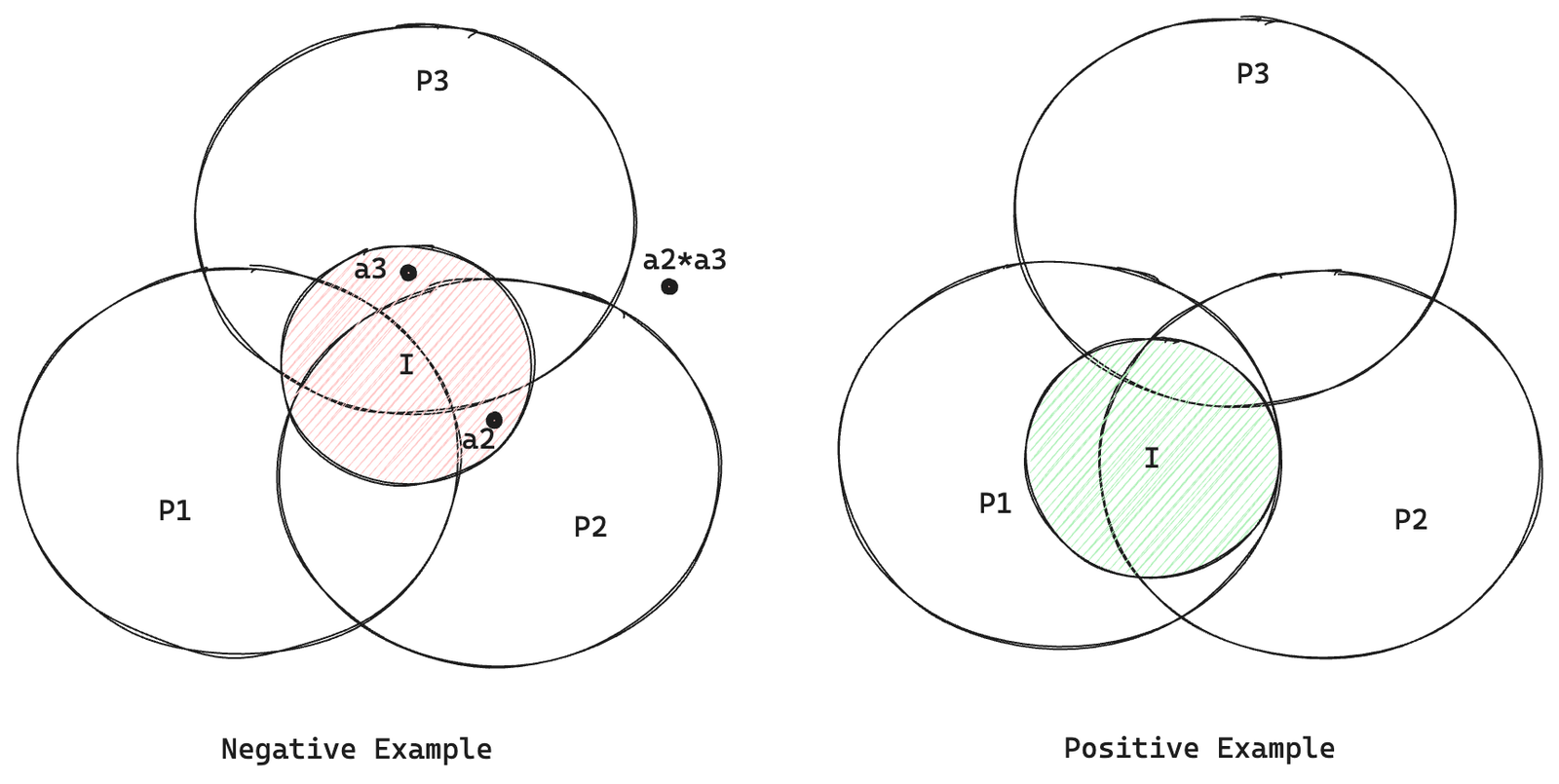
Now, let’s consider the general case when $n \ge 2$. A natural question arises: how to choose a proper $b$ such that $b \notin \mathfrak{p}_i$ for all $i \in \{1, \dots, n\}$? There is a simple fact : $$ a \in \mathfrak{p}_i, b \notin \mathfrak{p}_i \implies a + b \notin \mathfrak{p}_i $$ Let $b = \sum_{i = 1}^n \prod_{j \ne i}^n a_j$, where $a_j \in \mathfrak{p}_j$ and $a_j \notin \mathfrak{p}_i$ for all $i \ne j$. Then for the $i$-th term of $b$ , $$ \prod_{j \ne i}^n a_j \notin \mathfrak{p}_i $$ it does not belong to $\mathfrak{p}_i$ since $\mathfrak{p}_i$ are prime and all factors of the product are not in $\mathfrak{p}_i$. And for other terms except the $i$-th one are belong to $\mathfrak{p}_i$ since one factor of each of these terms is in $\mathfrak{p}_i$. Therefore, $b \notin \mathfrak{p}_i$ for all $i \in \{1, \dots, n\}$, moreover $b \notin \bigcup_{i=1}^n \mathfrak{p}_i$.
As shown in the above figure, the $i$-th term of $b$, $a_1 \cdot a_2$, is not in $\mathfrak{p}_i$. This mainly owe to the primality of $\mathfrak{p}_i$ which ensures that the product of elements not in $\mathfrak{p}_i$ is also not in $\mathfrak{p}_i$.
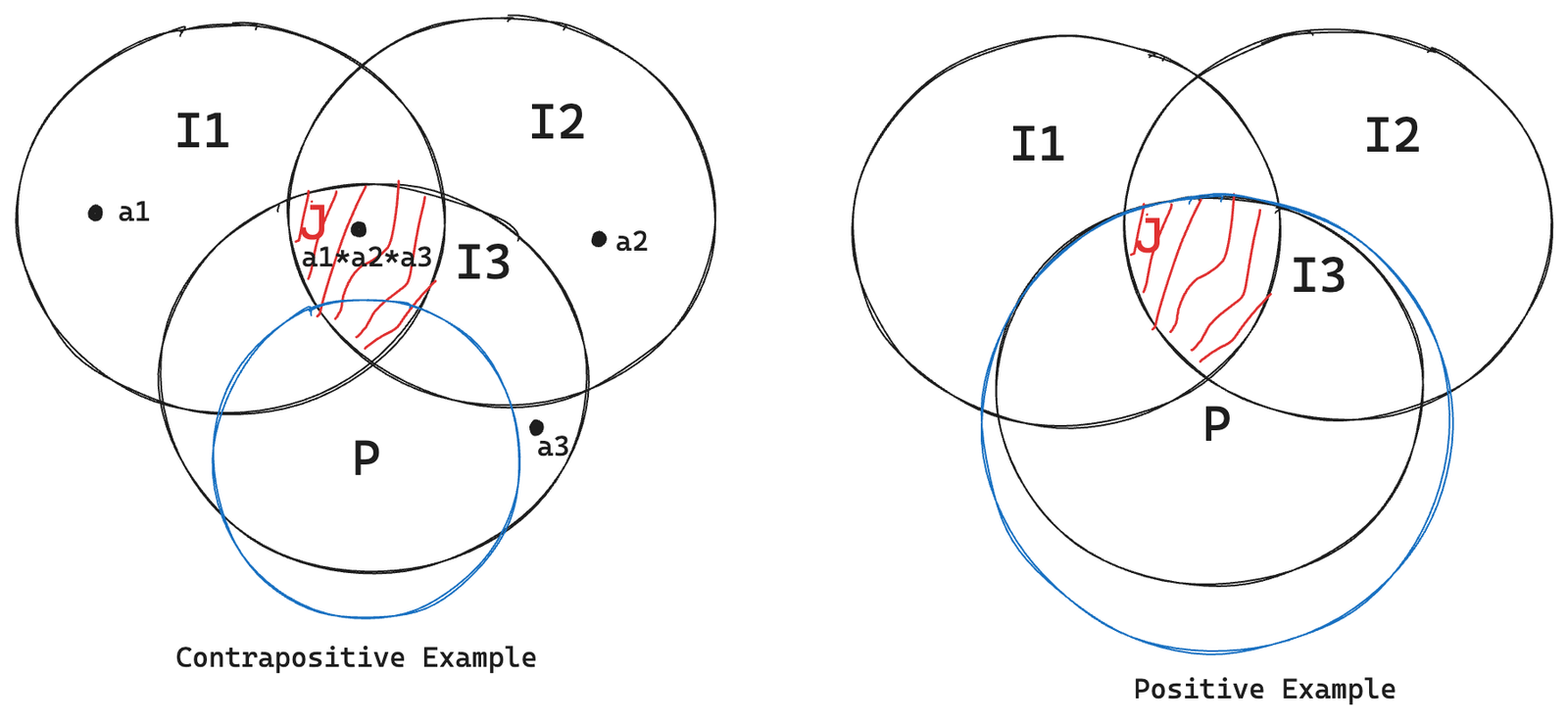
Regarding (2), let $J = \cap_i I_i$, the contrapositive way to show the statement is to prove $$ \begin{aligned} &\neg (\exists i \le n, I_i \subseteq \mathfrak{p}) \implies \neg (J \subseteq \mathfrak{p}) \\ &\iff (\forall i \le n, \exists a_i \in I_i, a_i \notin \mathfrak{p} ) \implies \exists x \in J, x \notin \mathfrak{p} \end{aligned} $$ We use $x = \prod_{i = 1}^n a_i$ where $a_i \in I_i$ and $a_i \notin \mathfrak{p}$. By the definition of ideal, $x \in \cap_i I_i = J$. And since $\mathfrak{p}$ is prime and none of the $a_i$ are in $\mathfrak{p}$, it follows that $x \notin \mathfrak{p}$. This completes the proof of the contrapositive.
As shown in the above figure, $x = a_1 \cdot a_2 \cdot a_3 \in \cap_i I_i$ but $x \notin \mathfrak{p}$, this mainly owe to the primality of $\mathfrak{p}$ which ensures that the product of elements not in $\mathfrak{p}$ is also not in $\mathfrak{p}$.
